Some of the most useful changes to the bicycle were small changes to familiar parts. A different angle in a derailleur, a better arrangement inside a hub, a simpler brake cable, and a more supple tire made bicycles easier to ride and live with. These four developments deserve a place among the practical revolutions of twentieth-century bicycling.
Slant parallelogram rear derailleurs
A rear derailleur has two jobs: move the chain sideways to select a sprocket, and take up the slack as the gearing changes. For clean shifting, its upper guide pulley also needs to stay close to the selected sprocket. Too much distance leaves a longer stretch of chain free to bend before it engages the next gear.
SunTour's slant parallelogram addressed this with geometry. As the derailleur moved inward toward the larger sprockets, its inclined linkage also moved the guide pulley downward. The pulley followed the slope of the sprocket cluster, keeping a more consistent gap across the gears. The original patent, filed in 1964, describes this coordinated movement.
That small change made accurate shifting easier to achieve. Riders still had to move a friction lever the right amount, but the derailleur put the chain in a better position to respond. It was an improvement you could feel at every gear change, without needing to see what was happening behind you.
The cassette rear hub
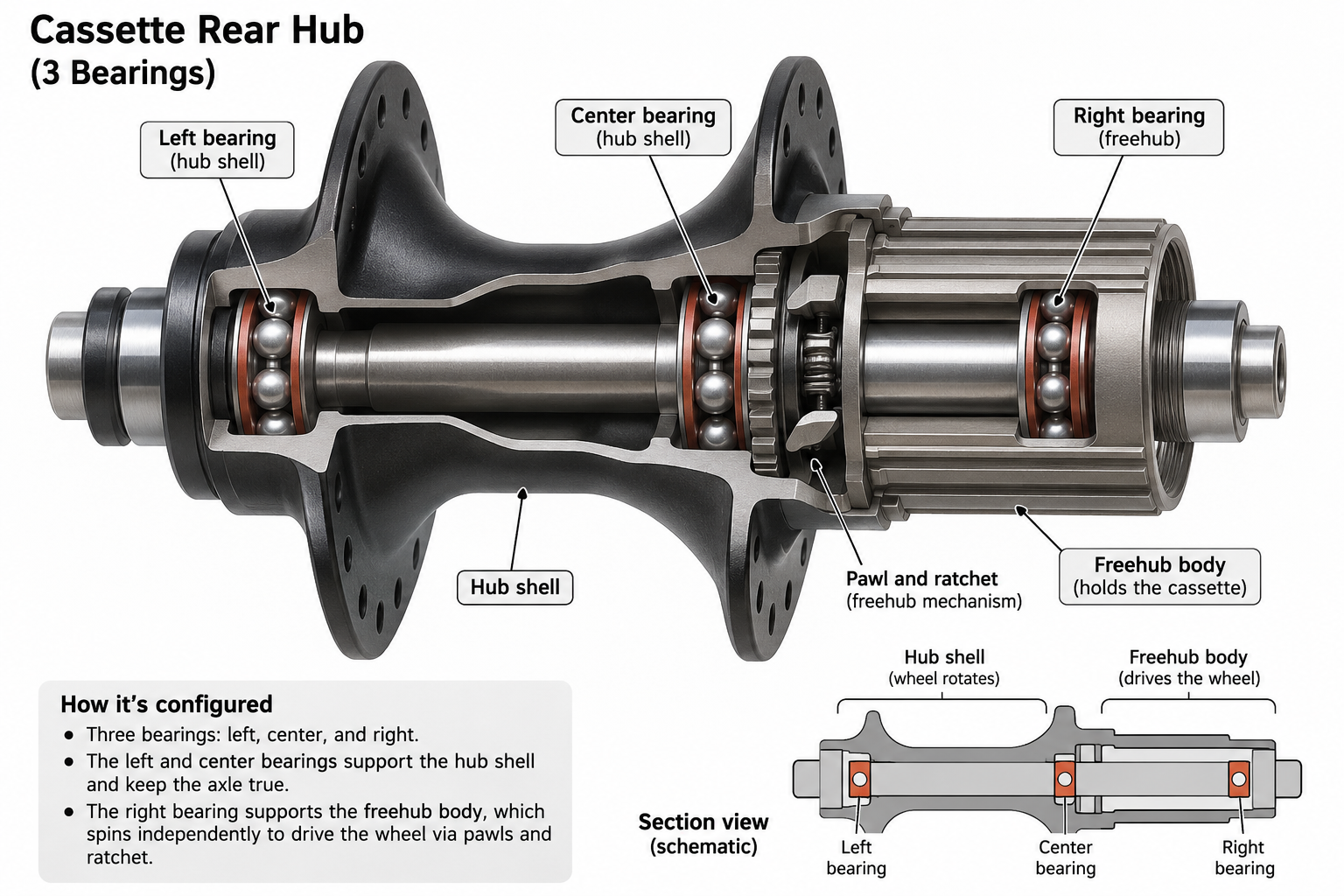
On a traditional screw-on freewheel, the sprockets and coasting mechanism form an assembly that threads onto the rear hub. Repeated pedaling tightens that assembly, sometimes making removal a struggle. The arrangement also commonly leaves a substantial length of axle unsupported between the right hub bearing and the frame.
A cassette hub separates the removable sprockets from the coasting mechanism. The sprockets fit onto a splined freehub body, while the ratchet stays with the hub. Shimano included a cassette-type hub in its 1978 Shimano 600 EX series.
The benefit went beyond easier sprocket replacement. Shimano's familiar freehub layout placed the right main bearing farther outward, closer to the frame, reducing the axle's unsupported span and its tendency to bend. That advantage became especially useful as rear sprocket clusters grew wider. Bearing placement varies among cassette hub designs, but this combination of convenient servicing and better axle support was a major practical advance.
V-brakes
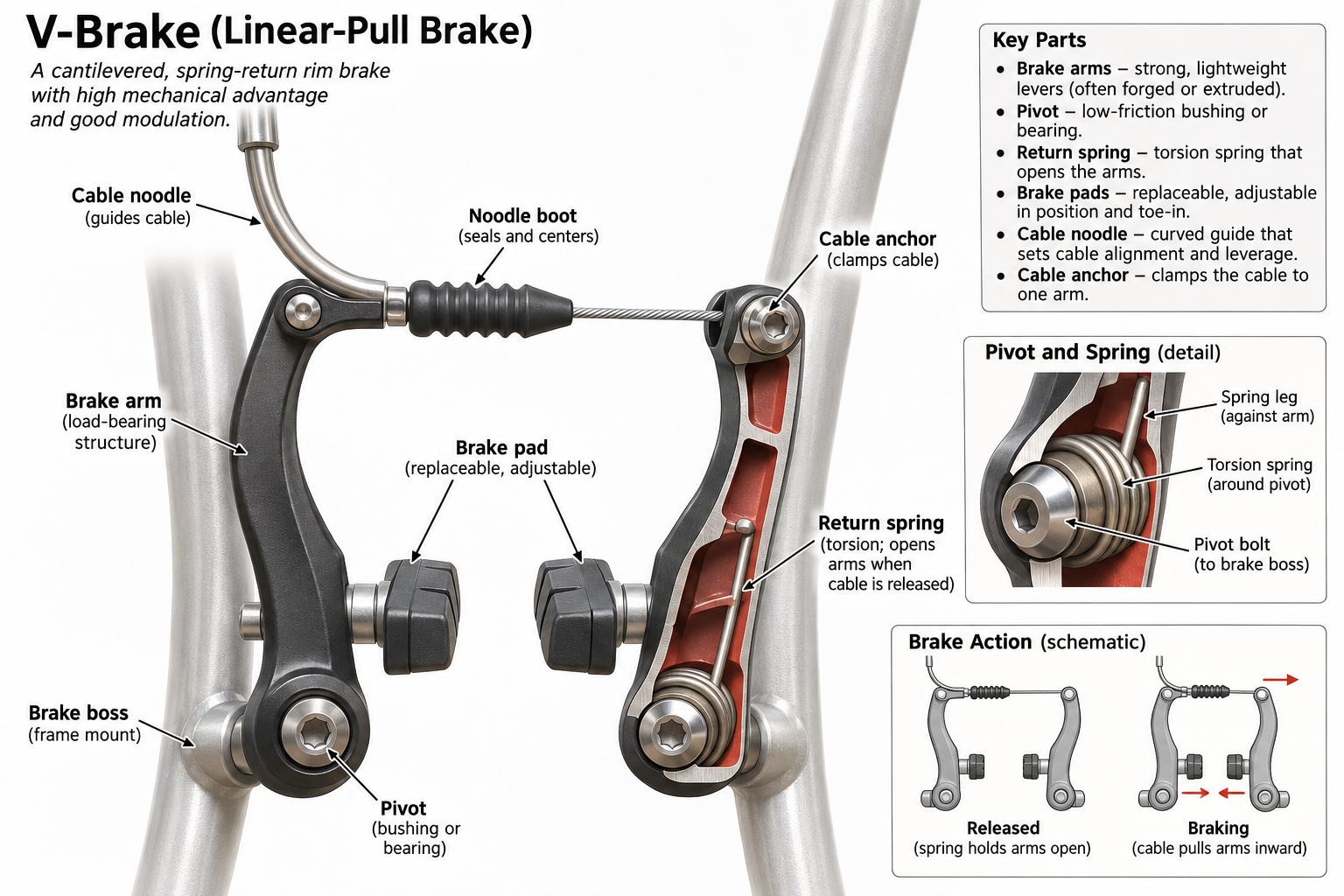
V-brakes gave the familiar cantilever rim brake a simpler cable arrangement. Two long arms pivot on the frame or fork, with the cable housing stopping at one arm and the inner cable attaching to the other. Pulling the lever brings the arms together and presses the pads against the rim. There is no separate straddle cable to position above the tire.
The long arms provide substantial mechanical advantage. With matching long-pull levers, riders get strong braking with manageable hand effort. Shimano's Deore XT history identifies increased braking force and control as benefits of its V-BRAKE development.
For mountain bikes, commuters, and touring bicycles, the appeal was straightforward: effective brakes with accessible pads, ordinary cables, and relatively simple adjustment. They still depended on the condition of the rim and pads, and wet rims still affected braking. Their achievement was making a powerful, serviceable rim brake easy to own.
Quality clincher tires
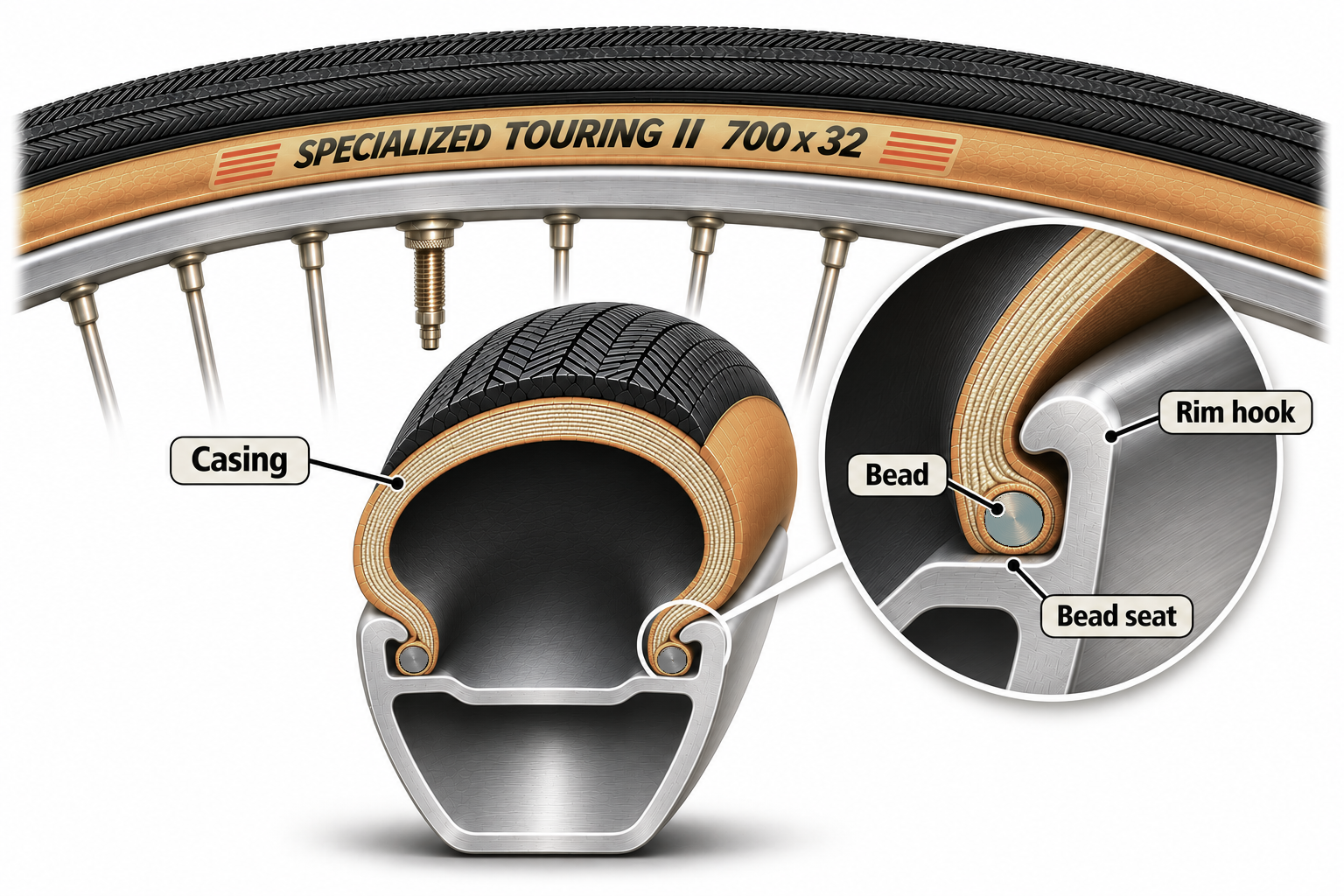
The clincher tire itself predates the twentieth century. The revolution here was its development into a high-quality performance tire. A clincher's beads hold it on the rim; in the conventional arrangement, a separate inner tube holds the air. A tubular tire instead has its tube sewn inside the casing and is glued to a special rim.
Better casings, rubber compounds, and bead construction helped clinchers combine good riding qualities with everyday convenience. A supple casing bends readily as the tire passes through the contact patch. Construction matters: a heavy, stiff tire and a light, flexible tire can feel very different even when their labeled dimensions match. Folding beads replace steel wire with flexible aramid fibers, reducing weight and making a spare easier to pack.
The practical gain was access to a lively ride with a tire that could be removed for a straightforward tube repair. Riders could replace or patch a tube without opening a sewn casing or gluing a tire back onto the wheel. As Schwalbe explains in its tire construction guide, modern folding clinchers can also match or surpass tubulars in rolling resistance. That performance developed over time; the lasting twentieth-century achievement was making quality tires increasingly practical for ordinary riders.